
How a Diagnostic report is created for a SMME
The Diagnostic report is a consolidated report, which incorporates the following tools/approaches to diagnose the business and propose the necessary interventions:
• GrowthWheel 20 focus areas
• Entrepreneur’s Personal Goals
• DISC Leadership profiling survey
• Entrepreneur Skills assessment
• 9 stages of business growth
• 6 steps to a successful business (ACTIONCOACH)
• SWOT
The diagnostic report has been customized to maximize the available tools and templates from GrowthWheel and the “Personal goal” focus area has been included to the four quadrants in the growth wheel. It is important for the Entrepreneur to be able to see their personal goals being achieved as they establish the business. Thus, there are specific fundamentals in the “personal goals” focus that forms part of the leadership coaching process.
The Enterprise diagnostic report supports the development of the business case for any development or grant funding requirements for the SMME.
To ensure that the Growthwheel status assessment is scored fairly and consistently, a questionnaire has been developed (<140 questions) to score the business along each focus area. Based on a scoring method, the questionnaire objectively arrives to an overall score per focus area, which then allows the Growthwheel assessment to be updated with the overall scores from the questionnaire. Where answers to the questions are ambiguous, the business advisor assess further through site visits and observations to finalize a clearly answer and more accurate score.
By performing a skills assessment, the business advisor can independently assess the business owner’s skills levels and compare it against the scores in each quadrant. In majority of the cases, where a quadrant has been scored low, the skills assessment score for that quadrant is also low, and thus the recommended intervention is for specific training to be initiated, before results can be seen in the quadrant.
However, there are cases where the skills level is sufficient, however the status of the quadrant is low. This reveals that the owner needs leadership coaching to encourage and motivate the owner to be confident in these skills and implement them to see immediate results. Some owners have basic skills to improve the business, however lack the time (time management skills) and ability to delegate (manage others skills) or research further on what to implement. Thus, the results of the comparison of the quadrant status scores versus the Skills assessment scores per quadrant is critical and assists in addressing the root cause.
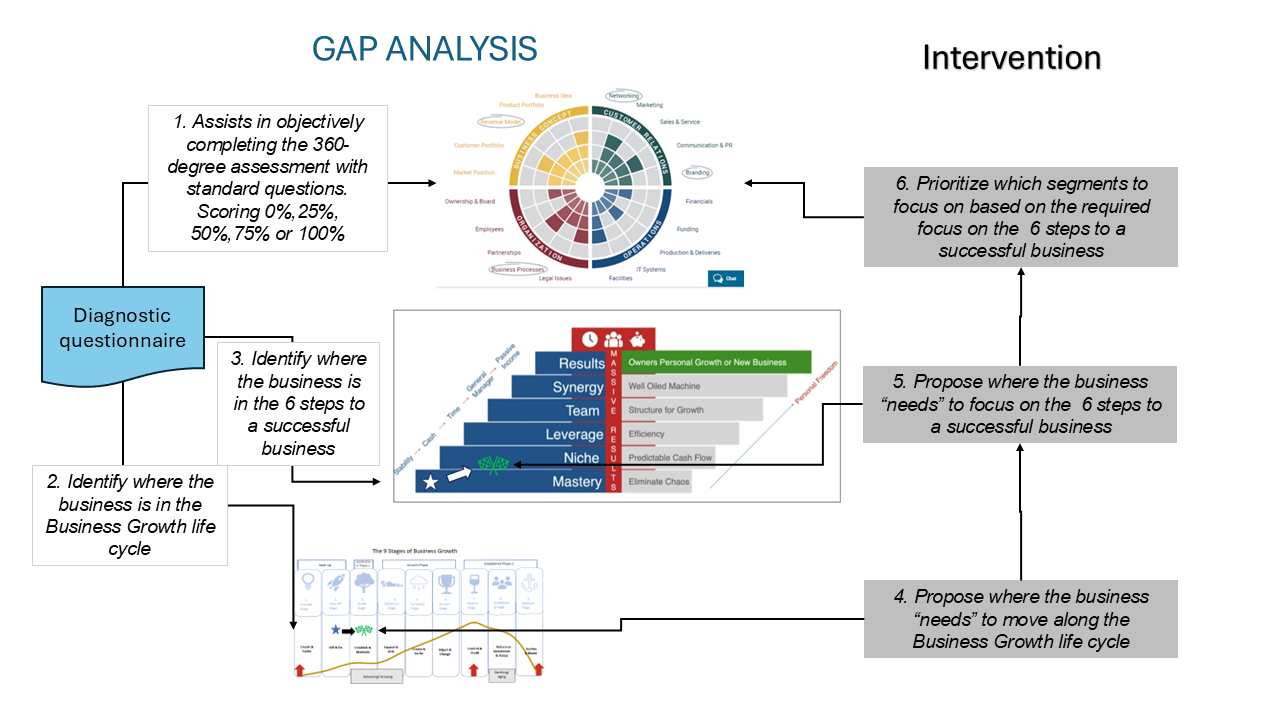
The image below shows the process of identifying gaps and then proposing interventions in a prioritized manner based on where in the roadmap the enterprise currently resides.
A diagnostic
assessment requires 30 hours to complete in collaboration with gathering
information from the Entrepreneur, especially if the enterprise is already
running.
The
following questionnaires will need to be completed by the owners of the enterprise:
·
Diagnostic questionnaire
(60min-90min to complete)
·
Skills
assessment questionnaire (40min-50min to complete)
·
DISC assessment questionnaire(12min-15min). The
DISC assessment is a measure of interpersonal behavior that is often used in a
workplace setting. It classifies how we interact in terms of four personality
styles which are Drive, Influence, Support and Clarity